Honey labels NZ producers send us cover the full category, from a Coromandel beekeeper bottling 200 jars of single-hive manuka to an export brand running 100,000+ on a manuka range bound overseas. The Label Room has been printing honey labels for over 18 years from our Auckland factory, across manuka, clover, multifloral, native bush and comb. Most producers run two channels in parallel: a domestic gift and tourism line that has to feel premium in the hand, and an export line that has to survive a long shipping route into overseas retail.
Why NZ honey producers choose us
Honey is the most regional category we print. Manuka country runs through the Coromandel, Northland and the East Cape. The Bay of Plenty contributes manuka and kanuka. The Marlborough Sounds brings multifloral and bush manuka, with Otago covering clover and alpine honeys from a colder climate. Hives are a long way from the producer’s office, and the producer’s office is usually a long way from a printer.
We travel through these regions and sit down at the extraction shed, packhouse or marketing office. A typical visit covers the whole programme: gift jars at the tourism stop, the retail line, and the export SKUs in bulk shipping. We bring sample packs, paper and BOPP swatches, foil chips and the printed proof of whatever’s in flight. Beekeeping is rarely a one-channel business, and the print work has to recognise that.
Built for the export shelf
Honey labels live a longer life than most food labels. An export jar sits in a sea container at variable humidity, then in distribution at temperatures the producer never sees, then on a supermarket shelf overseas. Honey residue ends up on every label that gets handled, so the print has to survive being wiped.
White and clear BOPP is the default for export. Synthetic, dimensionally stable, humidity-resistant, and the print sits under a lamination that wipes clean. For producers who want a paper aesthetic on an export line, treated uncoateds keep the natural look without the wrinkle and lift untreated paper gets when warm air meets cold glass in transit. Premium uncoated and textured papers stay on domestic gift work.
We don’t run thermal transfer stocks. Press heat on offset runs is too high. If you need an overprintable thermal label for batch coding downstream, talk to us about an alternative.
Premium finishes for premium honey
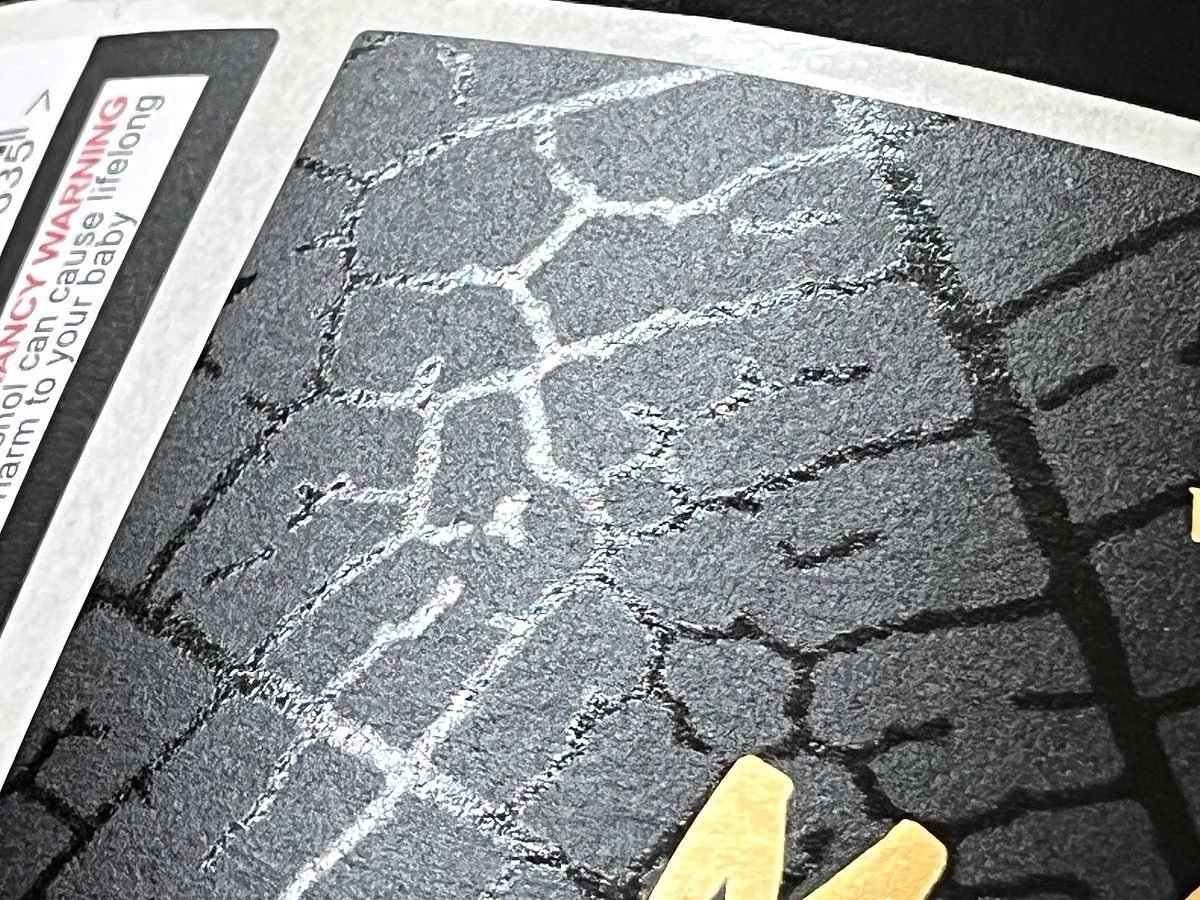
Manuka and reserve honeys command premium pricing, and the label has to earn that position before the cap comes off. Hot foil stamping in gold reads as the right colour for honey, picking up the warmth of the product itself. Silver and copper foils come in for native bush and darker honey work. Foil registers tighter than printed metallic ink and reads as proper metal.
Embossing adds tactile depth on a hero element, an apiary crest or a hand-drawn bee. A heavier cotton or linen paper takes a deeper emboss than a thin uncoated, so we proof emboss on the chosen stock before sign-off. Spot UV picks out a UMF rating or hero illustration against a matte ground, and raised UV adds a textural pop a customer can feel through the jar, useful on gift-pack work where the label has to earn its position before the lid comes off. Artisan-feel finishes lean uncoated and tactile. Export-grade finishes lean BOPP and laminated. The same brand runs both, printed to match.
Print method by run length: digital, offset, and how colour stays the same
Run length on honey is bimodal. Artisan and gift jars sit at the low end, 200 to a few thousand per release. Export manuka and supermarket lines sit at the high end, often 30,000 to 100,000+ per SKU per year. The same brand frequently runs both at once.
Digital is the call for the low end: artisan batches, single-hive releases, tourism gift hampers and reserve bottlings. No plates, no setup charge, artwork can change between SKUs without rework. Offset starts making commercial sense at roughly 10,000 labels per SKU, which is where export manuka core ranges and supermarket lines sit.
UV-cured offset runs on our hybrid press in our Auckland factory, with the digital press alongside as a separate machine. Shared colour targets are part of why colour holds across offset and digital, with the digital press colour-matched to the same Pantone references.
Say a Coromandel manuka producer runs an export 250g UMF 15+ at 80,000 a year, a domestic 500g multifloral at 14,000, and three single-apiary reserves at 400 jars. The core ranges run offset. The reserves run digital, printed to match, so the full lineup reads as one family from the tourism stop to the export shelf.
Stocks for honey labels
Substrate choice has to track the channel. Premium feel for gift, durability for export. Before you size the artwork, see the honey jar label sizes in our size guide.
- Premium uncoated and textured papers. Default for artisan and gift positioning. Holds emboss and foil well.
- White and clear BOPP. Export workhorse. Synthetic durability for shipping, customs handling and overseas retail. Clear BOPP gives the no-label look on premium export glass.
- Cotton and linen papers. Reserve manuka and gift pack work where the brief calls for a heavy tactile stock under deep emboss.
- Metallic gold paper. Premium manuka positioning. Useful as a base layer under spot colour and varnish, where the gold reads through the print.
- Treated uncoateds. Where a paper aesthetic has to survive humidity in transit. Common on export gift packs and duty-free tourism work.
Compliance: NZ honey and manuka labelling
Honey is one of the more regulated food categories in NZ, particularly anything sold or exported as mānuka. The label carries the standard food information set: product name, net weight, ingredients, supplier name and address, lot or batch code, date mark, storage instructions and a nutrition panel. Mānuka adds two more things: MPI’s testing rules and, on most brands, a UMF or MGO grade. UMF stands for Unique Mānuka Factor, a licensed grading system. MGO is methylglyoxal, and an MGO number gives its level in mg/kg. What the law says about testing and grades is covered in the questions below.
Allergens cover added ingredients in flavoured or comb-in-jar products. Country of origin has to be unambiguous on export. Destination markets layer their own rules on top, and China, the EU, the UK, the US, Japan and Australia all have specifics. Compliance review at prepress covers the NZ basics. Destination sign-off sits with your regulatory consultant, industry body or importer. The longer write-up lives at our honey export labelling guide. The free Food Label Checker flags likely issues on the basics, and you can generate a print-ready barcode if your label carries one.
From artwork to jar
A typical honey label job runs through four steps:
- Brief and quote. Send artwork or a mock-up with run length, jar format, channel (domestic, export, or both) and finish list. If the run is near the digital-to-offset crossover, we’ll price both.
- Prepress and proof. Preflight, Pantone matching and a physical proof on the actual stock. Compliance review for NZ honey and manuka basics happens here.
- Plate-making and press. Plates for offset, file prep for digital. First-off checked against the approved proof.
- Finishing and dispatch. Foil, emboss, spot UV, lamination, die-cutting, inspection and rewind to your applicator’s spec.
Budget 7-10 working days from proof approval for digital. First-run offset is 10-15 working days. Repeat offset off existing plates is 7-10. Call ahead if you need it faster.
Send a brief or give us a call. We’ll quote within a day, and bring a sample pack on the next regional visit if it makes sense.